Basement Flooding Case Study: How a Hidden Condensate Drain Line Caused Repeat Flooding
A basement flood can turn an ordinary day into a stressful emergency. And when the same problem keeps happening, homeowners deserve more than another temporary fix. They deserve a solution that addresses the underlying issue.
That was the situation one homeowner faced when we were called to investigate recurring basement flooding linked to a condensate drain that was not draining properly.
Key Takeaways
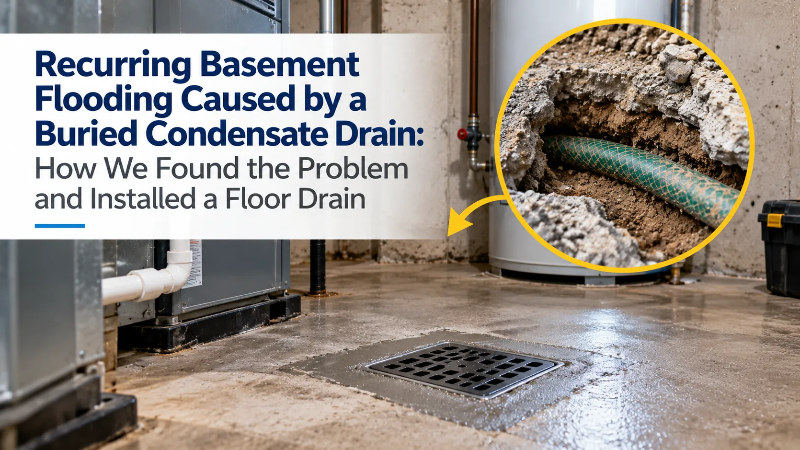
A garden hose buried beneath the concrete foundation, used as the condensate drain line, was the hidden cause of this homeowner's repeated basement flooding.
With no floor drain in the utility room, water had nowhere to go once that buried line stopped draining properly.
Fixing recurring flooding meant finding the real source of the problem first, not just cleaning up after another flood.
A new floor drain with a proper drainage connection was planned, installed, and completed in a single day.
A floor drain helps manage excess water, but it isn't a guarantee against every type of basement flooding; proper installation and drainage conditions matter just as much.
Harris Plumbing, Wells & Drains brings more than 52 years of local experience across Simcoe County, Muskoka, and York Region to diagnosing problems like this one.
The Problem: A Garden Hose Buried Beneath the Concrete
The homeowner contacted us in a panic after water began flooding the basement again. Unfortunately, this was not the first time they had experienced flooding.
During our investigation, we discovered an unusual installation: a garden hose had been buried beneath the concrete foundation and used as the condensate drain line. When the line stopped draining properly, water had nowhere to go. The utility room also had no floor drain to help carry away excess water.
With previous flooding incidents already causing concern, the homeowner needed a practical solution—not another cycle of leaks, cleanup, and uncertainty.
Basement flooding can have different causes, including plumbing problems, drainage issues, and water entering through the foundation. The Government of Canada provides guidance on actions homeowners can take to reduce flood damage.
The Solution: Find the Cause and Fix the Drainage Problem
Our team located the buried garden hose and assessed how to bypass the problematic installation.
Rather than treating the immediate symptoms, we developed a plan to install a new floor drain in the utility room, with an appropriate drainage connection, so that excess water could be carried away instead of accumulating on the basement floor.
The work required careful planning and attention to the existing conditions beneath the concrete. The objective was to provide the homeowner with a more dependable way to manage excess water and reduce the risk of further property damage.
Floor drains and other drainage components must be suitable for the property and installed in accordance with applicable requirements. Ontario’s 2024 Building Code Compendium, Part 9 — Housing and Small Buildings provides requirements relating to building drainage, foundation drainage, and floor drains. The applicable requirements depend on the building and the circumstances of the installation.
A Major Upgrade Completed in One Day
The new floor drain was completed in just one day.
For the homeowner, that meant a faster resolution to a stressful problem and a more practical drainage arrangement for the future. While the duration of similar projects depends on the property's layout, access, and complexity, our team worked efficiently to deliver this upgrade without unnecessarily prolonging the disruption.
A properly designed and installed drainage solution matters because recurring water problems can affect flooring, stored belongings, building materials, and the overall use of a basement.
Homeowners dealing with a basement leak should not have to guess at the cause. Identifying where the water comes from—and understanding where it should go—is an important part of resolving the problem.
The Government of Canada's basement window maintenance guidance also explains how water entry around basement windows and poorly maintained window wells can contribute to water damage. This is a useful reminder that the right solution starts with identifying the actual source of the water.
Why the Right Drainage Solution Matters
This project was about more than installing a drain. It was about addressing a weakness in the home's existing drainage arrangement.
A floor drain can provide a collection point for certain types of water, but its effectiveness depends on proper installation, an appropriate drainage connection, and the conditions that allow water to reach it. It is not a guarantee against every type of basement flooding. Slow drainage, a musty smell near a floor drain, or water pooling after it has been used are all signs that a drain is already struggling, and worth investigating before the next heavy rain or appliance cycle pushes it past its limit. The same goes for damp patches or discoloration on nearby walls and floors, efflorescence (a white, powdery mineral residue left behind by evaporating water), peeling paint, or warped woodwork near a utility room. Any one of these can mean water has been finding its way in for longer than you realize. If you're seeing more than a few puddles, or a sump pump that's running constantly, cycling oddly, or not keeping up at all, that's the point to call a licensed plumber rather than wait and see.
For homeowners concerned about recurring water problems, understanding the difference between a plumbing leak and water entering through the foundation is also important. These problems can have different causes and may require different solutions.
The Canada Mortgage and Housing Corporation's publication, Avoiding Basement Flooding, discusses practical measures for reducing basement water risks, including managing water around the home and maintaining appropriate drainage. These measures complement, but do not replace, investigating a specific plumbing fault.
Our work focused on the identified condensate-drain problem and the lack of a floor drain in the utility room. The result was a more practical arrangement intended to help manage excess water and reduce the likelihood of damage from a similar incident.
For additional guidance on basement water problems, see our article on basement flood repair and prevention.
What Else to Check When a Basement Keeps Flooding
A floor drain and a condensate line are only part of the picture. If your basement has flooded more than once, these are worth checking alongside the plumbing itself:
Sump pump maintenance and condition: test it by pouring water into the pit and confirming it activates and pumps efficiently; unusual noises or irregular cycling are early signs of a pump that's starting to fail. A typical sump pump installation across Simcoe County, Muskoka, and York Region runs roughly $1,000 to $3,000 CAD depending on basin depth and layout complexity, so a pump that's still working is worth protecting rather than replacing outright.
Battery backup: a sump pump with no battery backup can stop working during the power outages that often come with the same storms that cause flooding. Routine upkeep, checking the battery charge, inspecting for clogs, and cleaning the sump pit, typically runs $100 to $200 a year with a professional, which is modest next to the cost of a flooded basement.
Permits: some municipalities in Simcoe County and York Region require a permit before a sump pump or backup system is installed, usually in the $50 to $250 range, so it's worth checking with your local building department before work begins.
Gutters and downspouts: clogged or poorly directed downspouts let roof water pool near the foundation instead of carrying it away; downspouts should extend well clear of the foundation wall.
Soil grading: ground that slopes toward the house instead of away from it pushes surface water right back at the foundation, regardless of how well the interior drainage is working.
Floor drain debris: even a properly installed floor drain can back up if it isn't kept clear, so periodic clearing and testing matters as much as the initial installation.
Foundation Water Entry vs. Plumbing Leak: Basement Flooding Explained
The garden hose buried under this homeowner's foundation is a good illustration of why you shouldn't assume a basement flood is a foundation problem just because the water shows up on the basement floor. The actual source can be a hidden plumbing fault, a drainage gap, or water working its way in from outside, and each one points you toward a different fix. Here's how to start telling them apart before you call anyone.
Signal | Plumbing fault (e.g. condensate line, floor drain, supply line) | Foundation / exterior water entry |
|---|---|---|
Where you first notice water | Near a utility room, appliance, or fixture connection, often in one consistent spot | Along basement walls, window wells, or the floor perimeter, usually spreading inward |
When it happens | Any time the connected fixture or appliance runs, rain or no rain | Tends to follow heavy rain, snowmelt, or a rise in groundwater |
What's usually behind it | A failed or improperly installed drain line, a missing floor drain, or a blocked fixture, like the buried hose in this case | Grading that slopes toward the house, a deteriorating window well, or a crack in the foundation |
What it typically takes to fix | Diagnosing and repairing the specific plumbing component, sometimes paired with a new floor drain | Regrading, exterior drainage work, or window well repair |
Who to call first | A licensed plumber in Barrie or Newmarket, since this is squarely plumbing work | A plumber can help you rule a plumbing cause in or out, but the exterior fix itself may call for a contractor |
If you're not sure which side of this table your basement falls on, that uncertainty is exactly what an on-site inspection is for. You shouldn't have to guess at whether it's the pipes or the property.
The Harris Plumbing Difference: Long-Term Thinking
We believe good plumbing work starts with understanding the problem. As a family- and veteran-owned company with more than 52 years of local experience across Simcoe County, Muskoka, and York Region, we've learned that a recurring basement flood is almost always a sign of something more than bad luck.
That means taking the time to investigate unusual installations, identify the source of recurring issues, and develop a solution suited to the home, not addressing only the most visible symptom. Every completed repair is backed by fully licensed and insured journeyman plumbers, meeting the qualifications the province requires to perform plumbing work safely and to code, supported by senior apprentices trained under their direct supervision. As a veteran-owned company, we bring the same discipline, accountability, and follow-through to every job site, plus a one-year workmanship guarantee, so you're never left wondering if the fix will hold or whether the work was done right the first time.
Whether a homeowner needs help with a basement leak repair or another plumbing concern, the goal is to provide professional service, clear problem-solving, and workmanship that serves the homeowner's best interests.
This project demonstrates what that approach can look like: a stressful recurring problem, an unexpected discovery, and a practical upgrade completed in one day.
Serving Homeowners in Barrie and Newmarket
We believe homeowners in Barrie and Newmarket deserve plumbing solutions that take their property, their concerns, and their long-term needs seriously. Our Barrie office is at 18 Alliance Blvd Unit 7, and we also serve Newmarket homeowners directly from our office on Queen Street, so help is never far from either community.
If your basement has flooded more than once, or if a drain keeps backing up or failing to carry water away, it may be time to investigate the underlying cause rather than continue relying on temporary measures. Contact us to discuss your plumbing concerns and determine what solution may be appropriate for your home.
We get it done efficiently. We get it done professionally. And we approach every job with care for the people who depend on our work.
Because your home deserves more than a quick patch. It deserves a thoughtful solution.
Frequently Asked Questions
What causes basement flooding to keep happening even after cleanup?
Repeated basement flooding is usually a sign that the underlying cause was never addressed, not just bad luck. In this case, a garden hose buried beneath the concrete was being used as the condensate drain line, and the utility room had no floor drain, so once the line stopped draining, the water had nowhere to go.
How is a condensate drain line connected to basement flooding?
A condensate drain carries away the water your HVAC or other appliances produce. If that line is improperly installed, like being run through a buried garden hose, or it fails to drain properly, the water it should be carrying away can back up and flood the surrounding area instead.
Will installing a floor drain stop basement flooding for good?
A floor drain gives water somewhere to go, but its effectiveness depends on proper installation, an appropriate drainage connection, and the conditions that let water actually reach it. It isn't a guarantee against every type of basement flooding, which is why identifying the specific cause matters.
How long does it take to install a new floor drain?
In this project, the new floor drain was completed in a single day. Timelines vary with a property's layout, access, and complexity, but our team works efficiently to limit disruption while still doing the job properly.
What should a homeowner do if their basement has flooded more than once?
Rather than relying on temporary fixes, it's worth having the underlying cause investigated. A recurring flood or a drain that keeps backing up usually points to a specific issue, like a hidden plumbing fault or a drainage gap, that a proper inspection can identify and resolve.
Sources & Further Reading
This story draws on the following authoritative resources for context on basement flooding, drainage, and building requirements:
Government of Canada: Actions homeowners can take to reduce flood damage
Government of Canada: Basement window maintenance guidance
Ontario Building Code: 2024 Building Code Compendium, Part 9, Housing and Small Buildings
Canada Mortgage and Housing Corporation: Avoiding Basement Flooding