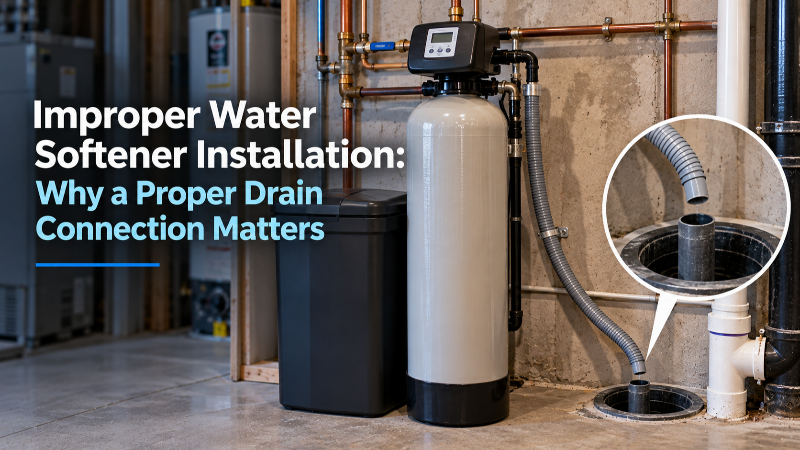
Improper Water Softener Installation: Why a Proper Drain Connection Matters
A water softener can help reduce hard-water problems, from mineral buildup on faucets to deposits on household appliances. But when it's installed incorrectly, it can create plumbing problems that go beyond hard water. When you install a water softener, proper plumbing connections and drainage arrangements are essential to help the system operate safely and reliably.
At Harris Plumbing, Wells & Drains, we encountered a case involving an improperly installed water softener, a drain-line arrangement with concerns about the required air-gap protection, and a strong sewage-like smell inside the home.
It was a reminder that installing a water softener involves more than connecting the equipment. The drain line matters, too, because it must be installed in a way that protects the plumbing system and follows the applicable requirements.
A sewage-like smell doesn't automatically mean the drinking water is contaminated. Still, when an unusual odour appears after a plumbing installation, it's worth finding out what's causing it.
What Happened in This Plumbing Case?
The homeowner noticed a strong sewage-like smell after a water softener had been installed.
During our assessment, we identified a concern with the drain-line arrangement because the required separation between the discharge and the receiving drainage system did not appear to be provided.
That separation helps protect against wastewater flowing or being siphoned back toward equipment or a potable water supply under certain conditions. Without the appropriate protection, the installation may create a potential pathway for contamination.
It's important to be clear about what this means. The installation concern needed attention, but the smell alone did not prove that sewage had entered the water softener or contaminated the home's drinking water. The source of the odour and any possible effect on the water supply would need to be assessed.
The lesson is simple: getting the plumbing connections right from the start can help prevent problems later.
Why Does a Water Softener Need a Proper Drain Connection?
A conventional water softener uses an ion-exchange process to reduce water hardness. During regeneration, it flushes accumulated hardness minerals from its resin bed and sends wastewater through a drain line.
That wastewater needs a suitable discharge arrangement installed according to the manufacturer's instructions and applicable plumbing requirements.
In Ontario, the Building Code's Part 7 plumbing provisions address indirect drainage connections for water-treatment devices and requirements for the associated air break. The correct arrangement depends on the applicable code provisions and the equipment being installed.
An improperly installed drain connection can create several problems:
Potential wastewater backflow: An inadequately protected connection may allow wastewater to flow back toward the equipment under certain conditions.
Contamination risk: If wastewater gains a pathway into the potable water system, the separation between clean water and waste may be compromised.
Drainage problems: Incorrect routing or an unsuitable receiving drain can contribute to leaks, backups or improper discharge.
Unpleasant odours: A sewage-like smell may point to a drainage, venting or other plumbing problem that needs investigation.
Not every missing air gap results in contamination. However, a missing or incorrectly configured protective arrangement should not be ignored where one is required.
What Is an Air Gap, and Why Does It Matter?
An air gap is a physical separation between a discharge outlet and the receiving fixture or drainage point. It helps prevent contaminated water from travelling backward through a connection into equipment or a potable water system.
An air gap and an air break are related, but they are not interchangeable terms. Ontario's Building Code addresses air breaks for indirect connections, including those involving water-treatment devices. The appropriate configuration must be checked against the applicable code provisions and the equipment's installation instructions.
Putting a drain hose into a standpipe or sewer connection doesn't automatically mean the installation is correct.
Manufacturers provide specific instructions for drain-line routing and discharge arrangements. For example, the Pentair Whole House Water Softening System installation and service manual explains drain-line and air-gap installation for the equipment it covers.
A qualified professional can check whether the existing arrangement provides the required protection, taking into account the softener model, receiving drain and applicable plumbing requirements.
Can an Improperly Installed Water Softener Make Your House Smell Like Sewage?
It can be one possible explanation, particularly when the smell starts soon after installation. However, a sewage-like odour can also come from drainage, venting, sewer-gas control, or another issue covered by our Drain and pipe services.
Possible causes include:
An incorrectly connected or terminated drain line.
Wastewater backing up or accumulating around the discharge point.
A missing or incorrectly configured air gap or other required separation.
A drainage or venting connection that isn't working as intended.
Another plumbing issue that happens to become noticeable around the same time.
The timing can help a plumber investigate, but it doesn't prove the cause on its own.
A sewage-like smell doesn't automatically mean the drinking water is contaminated. Even so, if wastewater may have entered the potable water system, take the possibility seriously.
Stop using the potentially affected water for drinking, cooking and brushing your teeth until the risk has been assessed. Use a safe alternative water supply and contact a qualified plumbing professional. If you rely on a private well, ask your local public health unit about appropriate testing and any necessary corrective action.
Ontario also provides guidance on testing and treating private water wells. The appropriate tests depend on the suspected contaminant and the circumstances.
If the smell persists, don't cover it up with air fresheners or assume it will go away. Finding and correcting the underlying problem is what matters.
Other Water Softener Installation Mistakes to Watch For
The drain line isn't the only part of an installation that deserves attention. Other mistakes can affect how well a water softener works and how reliably it operates.
Incorrect sizing
A water softener needs to match the household's water use, water hardness, treatment capacity and regeneration controls. Correct sizing starts with knowing the water hardness, usually measured in grains per gallon (GPG), and the household's average daily water use, often estimated at roughly 50 to 80 gallons per person. Multiplying hardness by daily usage gives the grain capacity the softener needs to handle between regenerations.
A system with insufficient capacity may regenerate too frequently or struggle to meet demand, which can shorten the resin bed's working life and increase salt and water use. An oversized system can also be inefficient if its capacity and settings aren't suited to actual water use, since it may sit idle for long stretches between regenerations, allowing stagnant water to sit in the brine tank.
Proper sizing helps the system treat the water effectively without unnecessary regeneration or avoidable operating costs. A water test and an honest look at household usage, rather than a generic size recommendation, are what get this right.
Reversed inlet and outlet connections
Water softeners have designated inlet and outlet connections. Reversing them can prevent the unit from operating as intended.
Always follow the manufacturer's markings and installation instructions rather than guessing which connection goes where.
Incorrect drain-line routing
Drain tubing needs to be sized, secured and routed according to the equipment instructions.
Restrictions, unsuitable elevations or incorrect termination can interfere with discharge performance. The receiving drain must also be appropriate for the installation.
A drain line that appears to work during normal operation isn't necessarily installed correctly.
Poor coordination with other water-treatment equipment
Some homes use several treatment devices, such as sediment filters, iron filters, water softeners, reverse osmosis systems or ultraviolet disinfection units.
The right order and connection arrangement depend on the water-quality concerns being addressed and the requirements of the equipment.
When several devices are installed, it's important to consider how they work together rather than treating each one as a separate appliance.
Installation Mistake | What It Looks Like | Why It Matters |
|---|---|---|
Incorrect sizing | Frequent regeneration cycles or water that never fully softens | Shortens resin bed life and wastes salt and water, or leaves hardness untreated |
Reversed inlet/outlet | Water bypasses the resin bed entirely | The unit runs but never actually softens the water |
Incorrect drain-line routing | Slow discharge, backups, or a drain line that looks fine until regeneration runs | Can cause leaks and improper wastewater discharge over time |
Poor coordination with other treatment equipment | Filters and softeners fighting each other or installed in the wrong order | Reduces the effectiveness of every device on the system |
Why Proper Installation and Workmanship Matter
Installing a water softener involves more than connecting a few pipes and switching on the equipment. The installer needs to understand the relevant water-supply and drainage connections, required backflow protection and applicable plumbing requirements.
Poor workmanship can lead to avoidable repair costs, leaks, drainage problems and potential contamination risks.
Homeowners should check that the person doing the work has the appropriate qualifications, authorization and insurance for the services involved. In Ontario, plumbing is a compulsory trade, and authorization requirements apply to work within its regulated scope, subject to applicable exceptions. You can read more in the province's guidance on compulsory trades and enforcement.
At Harris Plumbing, Wells & Drains, we've served Simcoe County, Muskoka and York Region for more than 52 years. Our team focuses on proper workmanship, applicable code requirements and dependable plumbing solutions. Our one-year workmanship guarantee applies to work covered by its terms.
When choosing an installer, ask how the drain line will be connected, what protective separation is required, how backflow risks will be addressed and whether the finished installation will be checked. A good professional should be able to explain the work and the maintenance your system needs.
What Should You Do If Your Water Softener Was Installed Improperly?
If you notice a sewage-like smell, unusual drainage behaviour or another problem after a water softener installation, here's what to do.
Note when the problem started. Did the smell appear immediately after installation, during regeneration or at another time? This information may help with the investigation.
Don't dismantle the equipment yourself. Avoid repairs involving pressurized water lines, electrical components or drainage connections unless you're qualified to do the work.
Arrange a professional inspection. Ask for the drain-line termination, required air gap or air break, backflow protection and nearby drainage and venting connections to be checked. If you suspect an installation problem, professional water softener repairs and a thorough inspection can help identify the cause and determine the appropriate next steps.
Take possible contamination seriously. If wastewater may have entered the potable water system, stop using the potentially affected water for drinking, cooking and brushing your teeth until the risk has been assessed. Use a safe alternative water supply and seek advice from the appropriate professional or public health authority.
Have confirmed defects corrected. The installation should be brought into compliance with applicable requirements and the manufacturer's instructions. Address the underlying problem rather than just the smell.
Follow appropriate testing or remediation advice. If contamination is suspected or confirmed, follow guidance from the relevant authorities and qualified professionals on testing and corrective action.
The goal isn't just to get rid of an unpleasant smell. It's to understand what's causing it and make sure the plumbing and water-treatment systems are working properly.
Protect Your Home With Proper Water Softener Installation
A water softener should help manage hard water without creating preventable plumbing problems. This case is a reminder that the drain connection deserves just as much attention as the equipment itself.
If a sewage-like smell develops after a water softener has been installed, don't assume the odour is harmless, or that contamination has definitely occurred. Have the situation assessed so the cause can be identified and the appropriate corrective action taken.
At Harris Plumbing, Wells & Drains, we believe good workmanship starts with getting the details right and explaining the work clearly.
Concerned About Your Water Softener's Drain Connection?
If you've noticed a sewage-like odour or suspect your water softener wasn't installed correctly, contact Harris Plumbing, Wells & Drains to discuss the issue and arrange an appropriate assessment.
Proper installation helps protect your plumbing system and gives you greater confidence in how your home's water-treatment system operates.
Frequently Asked Questions
How can I tell if my water softener's drain line has a proper air gap?
Look at how the drain tubing connects to the standpipe or receiving drain: there should be a visible physical separation between the end of the tube and the drain opening, not a tube pushed or sealed directly into it. If the tubing is inserted into the drain, glued, clamped, or otherwise fully connected with no visible gap, the required separation likely isn't in place. Because the correct configuration depends on the softener model and the applicable code provisions, a qualified plumber should confirm it rather than relying on a visual check alone.
Can I install or correct a water softener's drain connection myself?
Plumbing is a compulsory trade in Ontario, and the drain connection on a water softener involves both manufacturer installation instructions and applicable code requirements for indirect connections and air breaks. Getting it wrong can create the backflow and contamination risks described above without being obvious from the outside. Unless you're a qualified, authorized professional, it's best to have a licensed plumber install or correct the connection.
Does Harris Plumbing, Wells & Drains test well water if contamination is suspected?
Yes. We perform well water testing and work with Water Treatment Systems, Iron Filters, and UV Water Purifiers to help identify and address contaminants in private well water. If you suspect wastewater may have reached your water supply, we can help assess the situation alongside your local public health unit.
How often should a water softener installation be checked after it's first set up?
There's no need to inspect a correctly installed system constantly, but it's worth a periodic check, especially after any plumbing or renovation work nearby that could disturb the drain line, and any time you notice an unusual smell, slow drainage, or a change in how the system regenerates. A professional can confirm the drain connection, air gap or air break, and backflow protection are still intact.
What's the difference between an air gap problem and a simple drain clog?
A clog usually shows up as slow or backed-up drainage at the discharge point and tends to get worse gradually. An air gap or air break problem is about the configuration of the connection itself. It can exist even when the drain is flowing normally, which is why a drain that 'looks fine' isn't the same as a drain that's correctly installed.