Low Water Pressure in Innisfil? Is It the Well Pump or the Well?
If your Innisfil home relies on a private well, weak water delivery can have several possible causes. The issue may involve the pump, pressure equipment, filters, plumbing, or the well’s available water supply.
A running pump is not proof that it is delivering water correctly. Equally, low pressure does not establish that the pump has failed or that the well is running out of water.
The useful question is not, “Is the pump working?” It is, “Where does the system stop meeting the home’s water needs, and under what conditions?”
This guide explains which observations are useful, what they cannot prove, and what to ask before agreeing to well pump repair or replacement.
What Your Symptoms Can—and Cannot—Tell You

Start by noting where the problem occurs and how it changes during normal household use. These observations can guide an assessment, but they are not diagnoses.
What you notice | Why it matters | What it does not prove |
|---|---|---|
Only one faucet or shower has weak delivery | The fixture or its local connection may deserve attention first | A local fixture problem does not rule out a separate system issue |
Several fixtures weaken when used together | The problem becomes more noticeable as demand increases | That the well has insufficient yield |
Delivery improves after water use decreases | The timing helps describe how the system responds to demand | That the well is failing or needs deepening |
The pump starts more frequently than before | Pump cycling or pressure-system behaviour has changed | That the pump itself needs replacing |
The pump runs but delivery remains weak | Running and delivering adequate water are not the same thing | Whether the cause is the pump, a restriction, a leak, or the source supply |
An idle pressure reading looks normal, but flow weakens during use | The system needs to be evaluated under operating conditions | That a single normal gauge reading rules out a problem |
Record what happens during normal use. Do not deliberately run the system for an extended period to recreate a shortage.
Limit your checks to normal observations and readily visible equipment. Do not remove the well cap, open electrical controls, change pressure-switch settings, or attempt to access equipment inside the well.
If your home has no water, you notice damaged equipment, or you suspect an electrical problem, contact a professional promptly.
Is the Problem at One Fixture or Throughout the Home?
A problem affecting one fixture may have a different starting point from weak delivery throughout the property.
A restricted aerator, showerhead, supply valve, or fixture component can reduce flow locally. If several fixtures are affected, the assessment may need to consider shared piping, treatment equipment, pressure controls, pump performance, or the well supply.
Describe both the location and timing of the problem:
- Is one bathroom affected, or every tap?
- Does delivery weaken immediately or only after extended use?
- Does it change when another appliance starts?
- Is the problem new, intermittent, or gradually worsening?
The pattern helps determine what should be checked next, but it should not be treated as proof of a failed component.
Could the Pressure Equipment, Filters, or Plumbing Be Responsible?
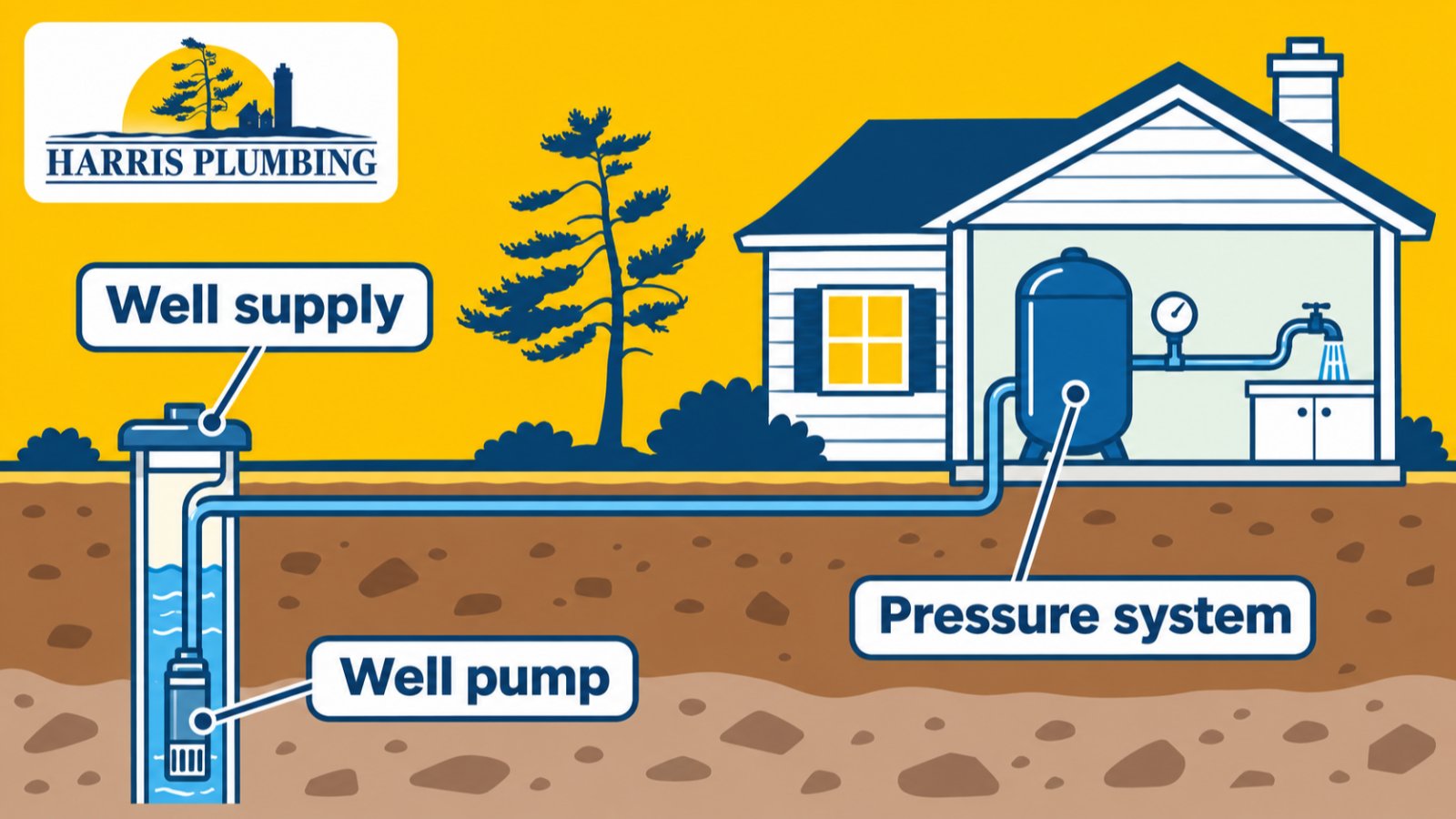
A well-water system includes more than the pump. Equipment should be identified before its operation is assessed.
Conventional systems may use a pressure tank and an on/off pressure switch. Other systems use different controls, so checks and adjustments must suit the installed equipment and manufacturer’s instructions.
Pressure Tank
In a conventional pressure-tank system, the tank provides usable water storage under pressure and helps reduce frequent pump starts.
Depending on the tank design, an incorrect air charge, a damaged bladder or diaphragm, or another tank fault may contribute to frequent cycling or pressure fluctuations. Those symptoms do not automatically establish pump failure.
A larger or additional pressure tank can increase usable drawdown—the water delivered between pump cut-out and cut-in in a conventional system. This may help buffer short demand peaks, but usable storage is less than the tank’s nominal volume and depends on the system settings and tank specifications.
Additional storage does not increase the rate at which groundwater enters the well. It may be insufficient when the supply shortfall continues over a longer period.
Ontario’s water-shortage guidance and Penn State Extension’s guide to using low-yielding wells explain why storage should be considered alongside well production and household demand.
Learn more about Harris Plumbing’s pressure tank services.
Pressure Switch and Other Controls
In systems with a conventional pressure switch, the switch controls pump operation in response to pressure settings. A switch fault, sensing problem, or other control issue can interfere with normal operation.
Other control arrangements require different checks. A professional should establish how the system is designed to operate before recommending changes.
Leave electrical inspections, tank-air-charge checks, and pressure-control adjustments to appropriately qualified professionals. Do not add air to a tank or change settings just because the pump is cycling frequently.
Filters, Valves, and Water Lines
A restricted filter or treatment component, partially closed valve, damaged pipe, or leak may affect delivery.
A professional may compare pressure at relevant points while water is flowing. For example, the pressure difference across a filter can help assess whether it is restricting delivery. That difference must be interpreted alongside flow rate and equipment specifications.
A normal reading while no water is being used does not rule out a problem under demand.
Why Pressure and Flow Need to Be Assessed Together
Water pressure and flow rate describe different aspects of performance:
- Pressure is force per unit area within the plumbing system, commonly expressed in pounds per square inch, or PSI.
- Flow rate is the volume delivered over time, commonly expressed in litres per minute or gallons per minute.
A shower may work normally on its own but weaken when another fixture operates. That does not identify a single cause. The system may have a restriction, inadequate delivery under those conditions, a control problem, or a limitation in the available supply.
This is why an idle gauge reading is only part of the picture. A useful assessment considers what happens while water is being delivered.
When discussing the findings, ask: “Was the system checked while water was being used, and what changed as demand increased?”
That question helps connect the recommendation to the conditions under which you experience the problem.
Could the Well Be Struggling to Meet Demand?
A well can experience a supply limitation even when the pump has no obvious mechanical fault.
Water availability depends on factors including construction, groundwater conditions, and the rate at which water enters the well. If withdrawal exceeds inflow, water stored within the well supplies the difference and its water level falls.
Water levels commonly fall during pumping. Drawdown alone does not establish that a well is failing. Its significance depends on pumping rate, duration, measured water levels, recovery, and whether the installation continues to meet the pump manufacturer’s operating requirements.
Delivery that improves after household use decreases may justify investigating the source supply, but equipment problems or restrictions can produce similar patterns.
Ontario’s guidance for managing wells during water shortages explains why groundwater conditions, demand, and equipment should be considered together.
What Water-Level Testing Can Establish
Where appropriate, a specialist investigation may consider:
- Static water level: the stabilized water level in the well when it is not being pumped.
- Pumping water level: the water level during pumping.
- Drawdown: the difference between the static and pumping water levels.
- Recovery: the rise in water level after pumping stops.
After pumping, sufficient recovery time is needed before a measurement can be treated as a static level.
These measurements need context, including pumping rate, test duration, well construction, and conditions at the time.
A pumping test can characterize performance under the conditions tested. It does not guarantee future availability or eliminate the possibility of seasonal changes.
Water-level measurements, pumping tests, and groundwater investigations are not necessarily included in a standard equipment-service appointment. Ask whether a separate specialist assessment is needed.
How Well Records and Pump Information Help
A well record may provide historical information about depth, casing, water-bearing formations, recorded water levels, and pumping-test results.
Search for available records through the Ontario Well Records Dataset.
Historical records provide a reference point, not confirmation of current performance. Separate installation and service records may also identify the pump, installation date, previous repairs, or intake position.
Why Pump Position Is Not a Standalone Solution
A submersible pump’s installation must suit the well, operating water levels, and manufacturer’s requirements. If water levels fall toward the intake, further investigation may be needed.
Lowering the pump is not automatically the correct response. Any change must account for construction, equipment requirements, and measured conditions.
For repairs or alterations, confirm the qualifications and licensing required for the work. Ontario’s resources on well construction and well maintenance and repair distinguish relevant requirements, exemptions, and recommended professional involvement.
What Should an Assessment Explain Before You Approve Work?

A useful recommendation should connect the proposed work to the findings, not just repeat the symptom.
Before approving a repair or replacement, ask:
Question | What you should understand |
|---|---|
What did the assessment identify? | The evidence supporting the suspected cause |
What was checked, and what remains untested? | The scope and limits of the assessment |
Is repair practical? | Why repair is or is not a reasonable option |
Why is replacement recommended? | How the replacement addresses the findings |
Could a restriction, leak, or supply limitation remain? | Whether other causes still need investigation |
What work and testing are included? | What the quotation covers and how completion will be assessed |
A plumbing or pump-equipment appointment is not necessarily a groundwater investigation or well-rehabilitation assessment. When booking, confirm what the visit includes and whether other work requires a specialist.
Learn more about Harris Plumbing’s well pump service and replacement.
What to Prepare Before Calling
You do not need to diagnose the problem. Gather what you can safely observe or already have on record:
- When the problem started.
- Whether one fixture or the whole home is affected.
- Whether delivery changes during simultaneous or extended use.
- Whether delivery improves after use decreases.
- Changes in pump cycling or operating time.
- Recent filter, tank, pump, or plumbing work.
- Available well records, installation details, and service reports.
Do not open equipment or change settings to prepare. If the system appears to be running out of water, avoid repeatedly operating it to test the symptoms.
Missing records should not delay contacting a professional.
Need Help With Low Well Water Pressure in Innisfil?
Low water pressure does not automatically mean the pump needs replacing. The next step is to establish whether the issue involves equipment, plumbing, or the available well supply.
Contact Harris Plumbing, Wells & Drains to describe the symptoms and confirm the assessment services available for your property. Ask which checks are included and whether specialist testing may be needed.
Explore well pump service and replacement or plumbing services in Innisfil.
Call (705) 730-7950. Online messages are not for immediate service requests; please call directly if you need urgent assistance.