What to Expect During a Well Pump Installation in Springwater
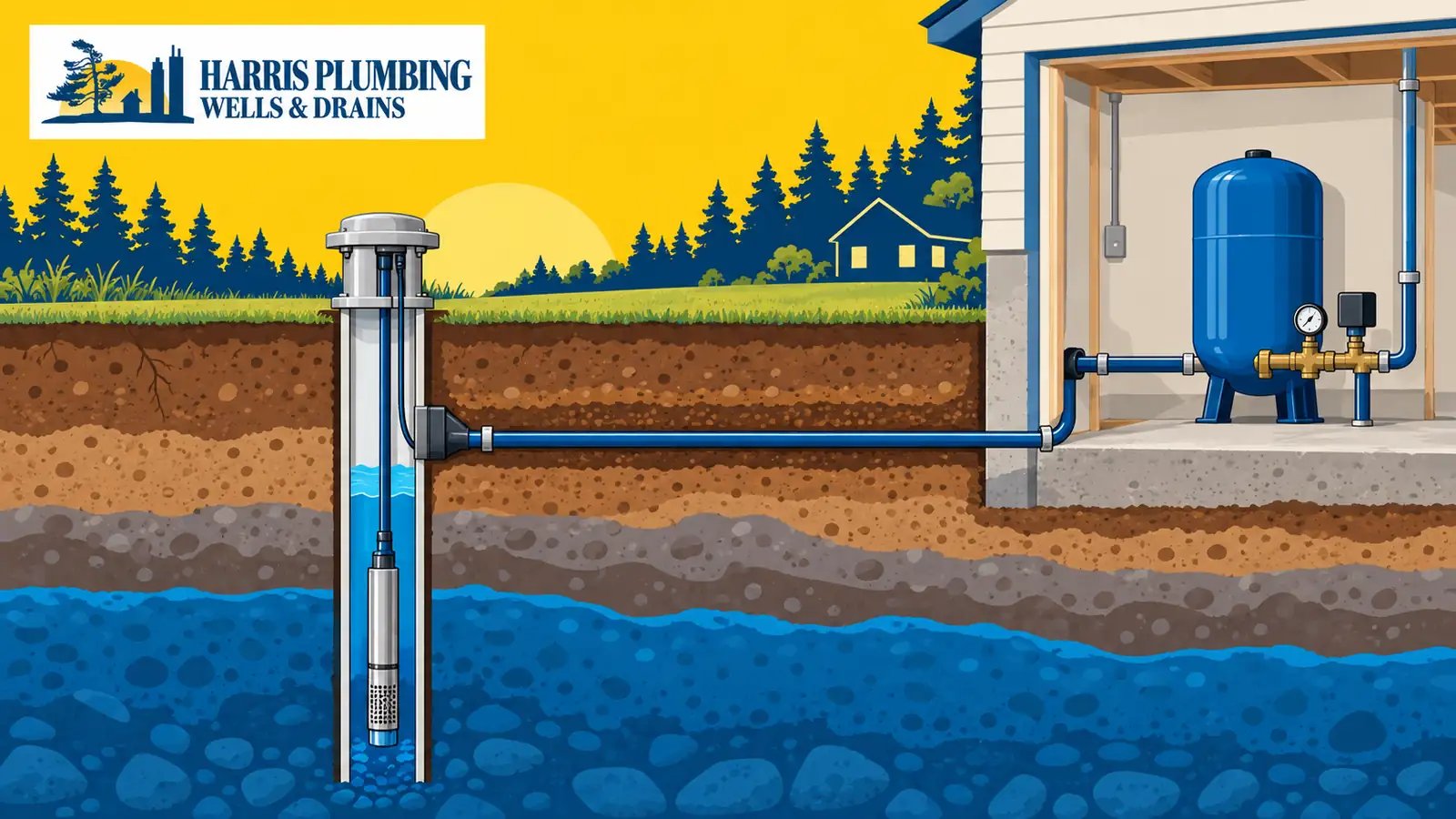
Planning a well pump installation involves more than selecting equipment. If your Springwater home relies on a private well, the pump needs to suit the well’s construction and operating conditions, deliver the required flow and pressure, and work with the property’s controls, electrical supply, and plumbing.
Whether the project involves a newly built home, an existing pump replacement, or a broader system upgrade, the starting point should be the available well information and the property’s water requirements.
Choosing equipment by horsepower or total well depth alone does not establish that it will perform correctly. A suitable installation depends on how the pump and the complete water system will operate together.
Start With the Well Record and Existing Equipment
Before selecting a pump, gather any available well and service records.
Useful information may include:
- The well record or well tag details.
- Total well depth.
- Casing diameter and construction information.
- Recorded static water level.
- Pumping water levels and test results.
- Recommended pumping rate.
- Previous pump installation and repair records.
- Details of the existing pressure tank and controls.
These records provide historical construction and testing information that can help guide equipment selection. They do not confirm the well’s current condition or guarantee its present capacity.
The installer should consider the records alongside current operating conditions and determine whether additional measurements or testing are needed.
Available records can be searched through the Ontario Well Records Dataset.
Why a Nearby Property’s Pump Is Not a Selection Guide
Two properties in the same community can have different well depths, pumping water levels, construction details, and water requirements. A neighbour’s pump size is not a substitute for assessing your own installation.
Ontario’s equipment-installation guidance identifies well construction, recommended pumping rate, water-level information, and other system conditions as relevant to pump selection.
Match the Pump to Demand and Operating Conditions
A pump needs to deliver the required water flow at the pressure the property needs while operating within the well’s available supply and the equipment’s requirements.
The selection process should consider:
Factor | What needs to be established |
|---|---|
Household demand | Expected water use, simultaneous fixture use, and additional demands such as irrigation |
Required flow | The volume of water the system needs to deliver under the selected design conditions |
Total dynamic head | Lift, elevation changes, required service pressure, and friction losses |
Well performance | Available test results, recommended pumping rate, and relevant current conditions |
System compatibility | Pressure tank, controls, power supply, piping, and treatment-equipment requirements |
A pump’s horsepower is only one characteristic. It does not, by itself, show how much water the pump will deliver in your system.
What Is Total Dynamic Head?
Total dynamic head describes the combined demand the pump must overcome to deliver water.
For a well-water system, this includes the lift from the pumping water level, elevation changes, required service pressure, and friction losses through piping and equipment.
A deep well does not necessarily mean the pump lifts water from the bottom of the well. The operating water level is an important part of the selection calculation.
A useful question for your installer is:
“What flow and total dynamic head was this pump selected for?”
Ontario’s equipment-installation guidance discusses total dynamic head and the relationship between pump performance and system requirements.
Well Yield Is Not the Same as a Pumping Recommendation
Available well-test results help describe performance under the conditions tested. They should be interpreted alongside the recommended pumping rate, test duration, water-level response, and current conditions.
The highest reported production figure should not automatically be treated as the rate at which a new pump should operate.
A pump selected to withdraw water faster than the well can supply it under the intended operating conditions can create water-availability problems. Selecting a larger pump does not increase groundwater inflow.
If records are incomplete or current performance is uncertain, ask whether further assessment is needed before equipment is selected.
Account for Well Construction and Pump Placement
The well’s dimensions and construction affect what equipment can be installed and how it should be positioned.
For a drilled well, relevant considerations may include:
- Casing diameter and available clearance.
- Total depth and construction details.
- Water-producing intervals.
- Measured pumping water levels.
- Pump dimensions and installation requirements.
- The proposed intake position.
The pump should not simply be placed as low as possible. Its installed position must suit the well, operating conditions, and manufacturer’s requirements.
Where water levels or construction details raise concerns, further assessment may be needed before installation proceeds.
Ontario’s well construction guidance explains relevant construction requirements, including casing and sealing.
Plan the Pressure Tank and Controls as Part of the System
The pump is only one component of the installation.
Depending on the design, the work may involve:
- A pressure tank.
- A pressure switch or electronic control system.
- Electrical wiring and protection.
- Check valves or other specified flow-control components.
- Drop pipe and well connections.
- Plumbing connections to the building.
- Filtration or treatment equipment, where appropriate.
The installer should explain which components will be replaced, which will remain, and why the retained equipment is compatible with the proposed installation.
Conventional On/Off Systems
In a conventional on/off system, the pressure tank provides usable water storage between pump cycles. The pressure switch controls pump operation at its configured settings.
The tank, switch, and pump need to be selected and configured together. Tank sizing and control settings should follow the relevant equipment requirements.
Variable-Speed Systems
Variable-speed systems manage pump output differently from conventional on/off arrangements.
Their controls and pressure-tank requirements must suit the selected design. Do not assume that equipment sizing or settings from one system can be carried over to another.
Ontario’s equipment-installation guidance discusses both conventional and variable-speed arrangements.
Water Treatment Requirements
Treatment equipment may affect the overall system design, including required flow and pressure.
If water testing identifies a treatment need, equipment should be selected for the actual water-quality concern and operating conditions. Installing a new pump does not establish that the water is safe to drink.
Learn more about Harris Plumbing’s well filtration systems.
Understand Installation and Commissioning
Once the equipment and scope are agreed, the installation can proceed according to the property’s conditions, manufacturer’s instructions, and applicable requirements.
The work may include:
- Reviewing the well information and existing system.
- Confirming the selected equipment and installation arrangement.
- Safely disconnecting and removing existing equipment, where applicable.
- Installing the pump, drop pipe, and required connections.
- Integrating the pressure equipment, controls, and electrical components.
- Checking operation, pressure behaviour, and water delivery.
- Explaining the installed equipment and any remaining recommendations.
Not every project includes all these steps. A new installation, a pump replacement, and a wider system upgrade can have different scopes.
Equipment installed in the well must be clean, connections must meet applicable requirements, and installation should follow the manufacturer’s instructions. Ontario’s equipment-installation guidance addresses these matters and relevant disinfection requirements.
Confirm Qualifications and Applicable Requirements
In Ontario, pump installation in or connected to a well is subject to applicable requirements under the Ontario Water Resources Act and the Wells Regulation, R.R.O. 1990, Reg. 903.
Licensing requirements and exemptions depend on the activity and circumstances. Confirm that the people performing the work hold the qualifications required for their specific tasks.
Do not assume that a general plumbing qualification alone authorizes every type of well-related work.
Ask About Disinfection and Water Testing
Before the work begins, ask which disinfection procedures apply to the installation and what follow-up steps are recommended or required.
Operational commissioning and drinking-water testing answer different questions. A system that delivers the expected pressure and flow has not, on that basis alone, been shown to provide safe drinking water.
Consult Ontario’s testing and treating private water wells guidance for information about water-quality testing and treatment.
What Information Should You Request at Handover?
Ask for enough information to understand the installed system and arrange future maintenance.
Useful details include:
- Pump make and model.
- Installation date.
- Pump setting depth, where applicable.
- Relevant control settings.
- Pressure-tank details.
- Manufacturer’s operating and maintenance instructions.
- Components replaced and components retained.
- Commissioning checks completed.
- Disinfection and follow-up water-quality instructions.
- Outstanding recommendations and warranty information.
These are useful homeowner requests, not a claim that every item is universally required documentation for every installation.
Keep the information with your well record and previous service reports.
Questions to Ask Before Approving the Installation
A clear proposal should explain both what will be installed and why it suits the property.
Before proceeding, ask:
- What well records and current information were used?
- What flow and total dynamic head was the pump selected for?
- How was the recommended pumping rate considered?
- Is additional well testing needed before selection?
- Is the existing pressure tank suitable for the proposed design?
- Which controls and electrical components will change?
- Will the pump setting depth change, and why?
- Which operating checks are included in commissioning?
- What disinfection and follow-up testing steps apply?
- Are permits, inspections, or separate specialist services needed?
- What equipment and installation information will be provided afterward?
The answers should connect the proposed equipment to the measured or documented conditions—not simply to a horsepower rating or the total well depth.
Well Pump Installation in Springwater
For Springwater homeowners, planning should begin with available well information, water requirements, and the condition of the existing system.
Harris Plumbing, Wells & Drains describes household water use, well depth, well yield, and pressure requirements as factors considered in its well-pump service information. Contact the company to confirm the installation and assessment services available for your property.
Explore Harris Plumbing’s well pump service and installation.
Call (705) 730-7950 to discuss your requirements. Have any available well records and equipment information ready, and ask which assessments, installation work, and commissioning checks are included in the proposed service.