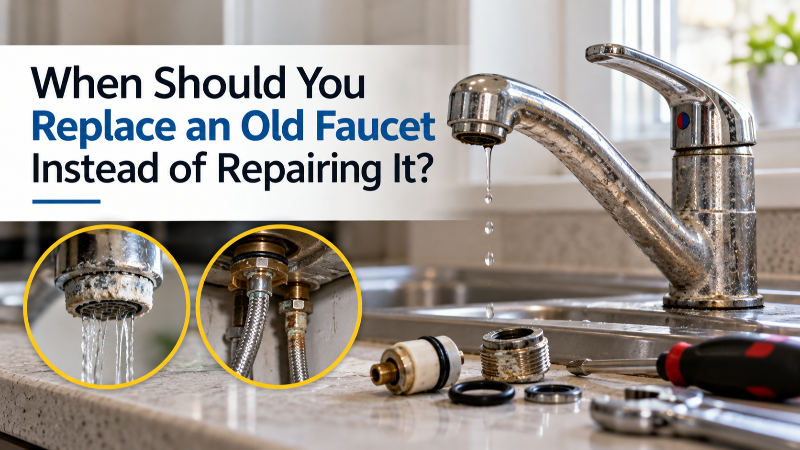
When Should You Replace an Old Faucet Instead of Repairing It?
Deciding whether to repair or replace a faucet isn't always straightforward. A leaking faucet doesn't always need to be replaced, sometimes changing a worn cartridge or seal is all it takes to restore normal operation. But when an older faucet has recurring leaks, significant mineral buildup, or several deteriorating components, knowing when to replace a faucet versus repairing it again becomes an important long-term decision.
At Harris Plumbing, Wells & Drains, we understand why homeowners often ask for the least expensive repair. As a family- and veteran-owned company with more than 52 years of local experience serving Barrie, Simcoe County, Muskoka, and York Region, our certified and insured plumbers have seen enough faucets fail and get repaired again to know the difference between a quick fix and a lasting one. We want to solve the immediate problem without recommending unnecessary work. At the same time, we believe customers deserve to understand the condition of the entire fixture, not just the part responsible for today's leak.
We've encountered situations where we repaired one leaking component, only for the customer to call again a few months later because a different component had failed. Those experiences have taught us an important lesson: a successful repair fixes the identified fault, but it doesn't restore every aging component inside a faucet.
Here's how we approach that decision and what homeowners should consider before spending more money on an older fixture.
1. Identify the Source of the Leak Before Deciding What to Replace
The location of a leak can help narrow down the possible causes. However, the visible symptom alone doesn't always identify the faulty part.
For example, manufacturer troubleshooting guidance from Moen explains common faucet leaks and their possible causes. Depending on the faucet design, worn cartridge seals, damaged O-rings, or other components may be responsible. The correct replacement part depends on the specific model.
Here are several symptoms worth distinguishing:
What you notice | What should be investigated |
|---|---|
Water continues dripping from the spout when the faucet is off | The cartridge, valve, or sealing components may not be closing properly. |
Water leaks around the handle | The cartridge, seals, or other internal components may need inspection. |
Water appears around the base of the spout | The cause may involve O-rings, seals, or another model-specific component. |
Water is pooling underneath the sink | The faucet connections, supply hoses, shut-off valves, and surrounding plumbing should be checked. |
Water flow has weakened or the spray pattern has changed | The aerator may be clogged with debris or mineral deposits, although other causes are possible. |
These are diagnostic starting points, not definitive diagnoses. A leak underneath a sink, for instance, may come from a supply connection rather than the faucet itself.
The distinction matters because replacing the entire faucet won't necessarily resolve a leak originating from a separate plumbing connection. Equally, repeatedly replacing a small component without identifying why the problem persists can lead to unnecessary expense.
Before recommending repair or replacement, we want to establish what is actually failing.
2. What We Look for Inside an Older Faucet
Once we've identified the likely source of a leak, we consider the overall condition of the fixture.
A faucet may look presentable on the outside but have worn seals, mineral deposits, damaged threads, or corrosion around internal or mounting components. These conditions can affect how practical a repair will be.
We pay particular attention to the following:
The condition of the failed component. A worn cartridge or damaged seal may be a straightforward repair if the remaining fixture is in good condition.
The condition of surrounding parts. If nearby seals or other components also show deterioration, we consider whether the problem is isolated or whether additional work may be needed.
Mineral buildup. White or chalky deposits can be consistent with hard-water scale. Health Canada explains that calcium and magnesium contribute to water hardness and that scale can accumulate on plumbing fixtures and inside household equipment. Its Guidelines for Canadian Drinking Water Quality: Operational Parameters provide more detail.
Corrosion and physical damage. Corroded components, damaged threads, or mounting hardware that can no longer hold securely may complicate a repair. Their significance depends on the location and severity of the damage.
Parts availability. Even when a faucet can technically be repaired, obtaining the correct replacement cartridge, seal kit, or other model-specific component may be difficult or uneconomical.
None of these findings automatically means the faucet must be replaced. They help us determine whether a repair is likely to be a sensible use of the homeowner's money.
3. Why One Successful Repair Doesn't Guarantee the Next
Consider a situation we've encountered in our work.
A customer has an older faucet that is leaking. We investigate the problem, replace the faulty component, reassemble the faucet, and test it. The original leak stops, and the faucet operates normally when we leave.
Three or four months later, the customer contacts us again. The faucet is leaking, but the source is different.
The first repair may have been successful. The second problem may involve a separate component that has since failed.
This is where expectations can become difficult to manage. From the homeowner's perspective, money was spent repairing the faucet recently, so another leak can feel like the original repair didn't work.
We understand that frustration. That's why we believe it's important to explain the difference between a defect in completed workmanship and a separate component failure.
Harris Plumbing provides a one-year workmanship warranty, but whether a subsequent problem is covered depends on the circumstances and applicable warranty terms. A separate component failure is not automatically the same as a defect in the original repair.
When we find an older fixture with several warning signs, we want the homeowner to understand this possibility before choosing another repair. We cannot predict exactly when another component will fail, but we can explain the condition we observe and discuss the available options.
4. Compare the Full Cost of Repair With the Cost of Replacement
The price of a replacement part is only one part of the decision.
A repair estimate may include diagnosis, disassembly, labour, replacement components, reassembly, and testing. If a separate problem develops later, another service visit may be necessary.
For example, labour for a service visit may be $150 or more, depending on the work involved. If several repairs eventually total around $600, the accumulated leaking faucet repair cost may be worth comparing with the cost of installing a new faucet.
These figures are illustrative examples from the kind of cost considerations we discuss with customers, not universal prices or a claim that replacement is always cheaper.
A fair comparison should include:
The current repair: the expected total cost of diagnosing and fixing the identified fault.
The condition of the fixture: whether there are additional signs of deterioration that could require attention.
The likely availability and cost of parts: whether the necessary components can be sourced at a reasonable price.
The replacement option: the price of the new faucet, installation labour, and any necessary changes to connections or mounting hardware.
Previous repair expenses: what the homeowner has already spent and whether another repair offers reasonable value.
Past repair costs are useful context, but they should not determine the decision by themselves. Money already spent cannot be recovered. The important question is whether the next repair makes sense compared with the alternatives available today.
A relatively expensive repair can still be worthwhile when the faucet is otherwise sound. A cheaper repair may be less attractive when repeated failures and the condition of the fixture suggest that more work could be needed.
5. When Does Faucet Repair Make Sense?
We generally favour repair when the fault is clearly identified, the faucet is in reasonable condition, suitable parts are available, and the cost is proportionate to the expected benefit.
Replacement becomes more worth considering when several warning signs appear together, these are some of the clearest signs you need a new faucet rather than another repair.
Consider repair when:
The problem is isolated to one identifiable component.
The body and mounting hardware remain in good condition.
The correct replacement parts are available.
The faucet has not required repeated repairs.
The repair is substantially more economical than replacement.
Consider replacement when:
Several components show signs of deterioration.
Corrosion or physical damage affects important components.
Parts are unavailable or disproportionately expensive.
Similar problems have returned after previous repairs.
The full repair cost is approaching the installed replacement cost.
This isn't a rigid rule. When weighing faucet replacement vs repair, a high-quality faucet may be worth repairing even when the part is expensive, while a relatively inexpensive fixture may not justify extensive work. The answer depends on the specific faucet, the cause of the problem, and the customer's priorities.
We explain what we find and why we recommend a particular option. We don't believe every older faucet should be replaced just because it's old.
6. Could Hard Water Be Contributing to the Problem?
Sometimes, the condition of a faucet raises another question: is the fixture experiencing an isolated mechanical problem, or is there a wider water-quality issue worth investigating?
Hard water contains dissolved minerals, principally calcium and magnesium. When mineral deposits accumulate, they can leave visible scale on fixtures and restrict the flow through small openings such as aerators.
Routinely monitoring faucets for leaks and inspecting fixtures for scale or calcium buildup is good practice for any home. Cleaning a clogged aerator may improve flow when deposits are the cause.
This is useful because not every faucet problem requires a replacement. A restricted aerator, for example, may be cleaned or replaced without replacing the entire fixture.
However, visible scale doesn't prove that hard water caused a particular cartridge or seal to fail. Nor does one leaking faucet establish that the whole home has a water-quality problem.
We become more interested in further investigation when we see a pattern—for example, substantial mineral buildup on several fixtures alongside recurring problems. In that situation, water testing may help determine whether hardness or another water-quality characteristic needs attention.
For homeowners using private wells, the Government of Ontario's guidance on testing and treating private water wells explains the importance of testing water and selecting treatment based on the issue identified.
A water softener may help with hardness-related scale, but it won't repair worn faucet components or solve every plumbing problem. If a water softener is already installed and isn't performing as expected, our water softener repair services may be relevant. We would first need to understand the symptoms and determine whether the problem involves the treatment equipment, the water supply, or something else.
Our goal is to investigate the evidence before recommending a treatment system—not to assume that every faucet failure requires one.
7. Five Questions to Ask Before Approving Another Repair
Before spending more money on an older faucet, we encourage homeowners to ask their plumber these five questions:
Where exactly is the leak coming from? Confirm whether the problem is inside the faucet or at a separate plumbing connection.
Which component needs to be replaced, and why? A clear explanation helps distinguish diagnosis from guesswork.
What condition are the remaining components in? Ask whether the inspection revealed any additional concerns, without assuming that every worn part needs immediate replacement.
What is the full cost of repair compared with replacement? Compare the installed costs and the work involved, not just the price of a cartridge or new faucet.
What does the warranty cover? Understand the distinction between workmanship, the replacement part, and a separate future failure.
These questions won't guarantee that one option will cost less over the long term. They help ensure that the decision is based on a diagnosis, the fixture's condition, and a realistic cost comparison.
Our Approach: Treating Your Home Like Our Own Family's
We know that unexpected plumbing expenses can be frustrating. We also understand why homeowners want to repair a faucet instead of replacing it whenever possible.
This is why we look beyond the single leaking component to how the faucet, the supply connections, and the surrounding plumbing work together. A faucet rarely fails in isolation from the system feeding it, so an inspection that stops at the first worn part can miss a condition that leads to the next service call.
At Harris Plumbing, Wells & Drains, we want customers to know the difference between fixing today's leak and assessing the condition of the entire fixture. Sometimes, a repair is exactly the right choice. In other situations, replacement may offer better value.
If we notice signs that a recurring issue may extend beyond one faucet, we'll explain why further investigation might be worthwhile. We won't assume that every problem has the same cause, and we won't promise savings we cannot substantiate.
Our guiding principle is simple: imagine that the customer's house is our mother's house. We would want our own family to receive a clear explanation, understand the options, and make a decision without pressure.
If you're dealing with a leaking faucet or another bathroom plumbing issue, explore our bathroom plumbing services. You can also visit our plumbing services homepage to learn more about how we help homeowners with their plumbing concerns.
The best decision isn't automatically the cheapest repair or the newest faucet. It's the option that makes sense for the condition of the fixture, the cost involved, and the homeowner's needs.